
Illustration & Design
Bauhaus
Style guide
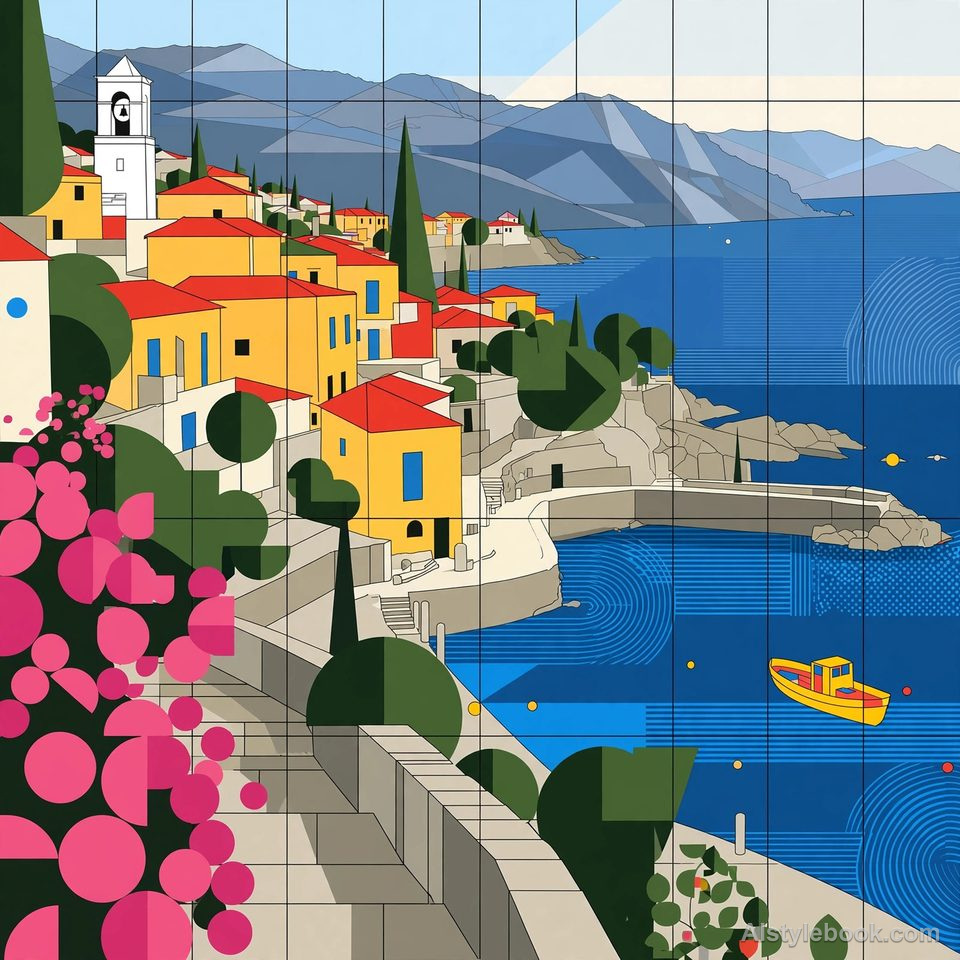
Primary-color geometry and precise proportions establish a rational structure with restrained, forceful Bauhaus character.


The visual language
What is Bauhaus?
Circles, squares and triangles form a rational order through their size and placement, with primary colors set against black and white. Flat proportions carry the image while preserving structural relationships.
Bauhaus names a school and design approach, beyond any single primary-color pattern.
A teapot reduced to a circular body, straight handle and triangular spout makes the relationships between components visible.
How the style changes different subjects
- Portrait
- Geometric contours and color shapes reduce facial detail, emphasizing placement, proportion and open space.
- Landscape
- Lines, planes and grids organize buildings and terrain around spatial order rather than texture.
- Objects
- Circles, rectangles and straight lines break objects into balanced compositional elements.
- Subjects
- Choose geometric buildings, tools, clear figures or orderly object arrangements with distinct colors and scales.
An art and design school
Founded in Germany by Walter Gropius in 1919, the Bauhaus brought artists, architects and designers into a shared educational setting.
Bring the style to your photos
Reusable style prompt for Bauhaus
Distill the subject into geometric relationships made from circles, squares, triangles, and simple straight lines, preserving the most important connections between contours. Use red, yellow, and blue with black, white, and a few neutrals. Keep fields flat and boundaries precise. Establish rational order through size relationships, line weight, and positive-negative contrast, giving forms restrained functionalist strength. Omit realistic materials, complex gradients, and unnecessary ornament.Use the same style prompt for portraits, landscapes and objects.
Create with this styleKeep exploring


