
Illustration & Design
Isometric
Style guide
Parallel edges and consistent isometric projection create a rational space, with pastel planes and simple shadows emphasizing geometric volume.

PortraitStyle effect

LandscapeStyle effect
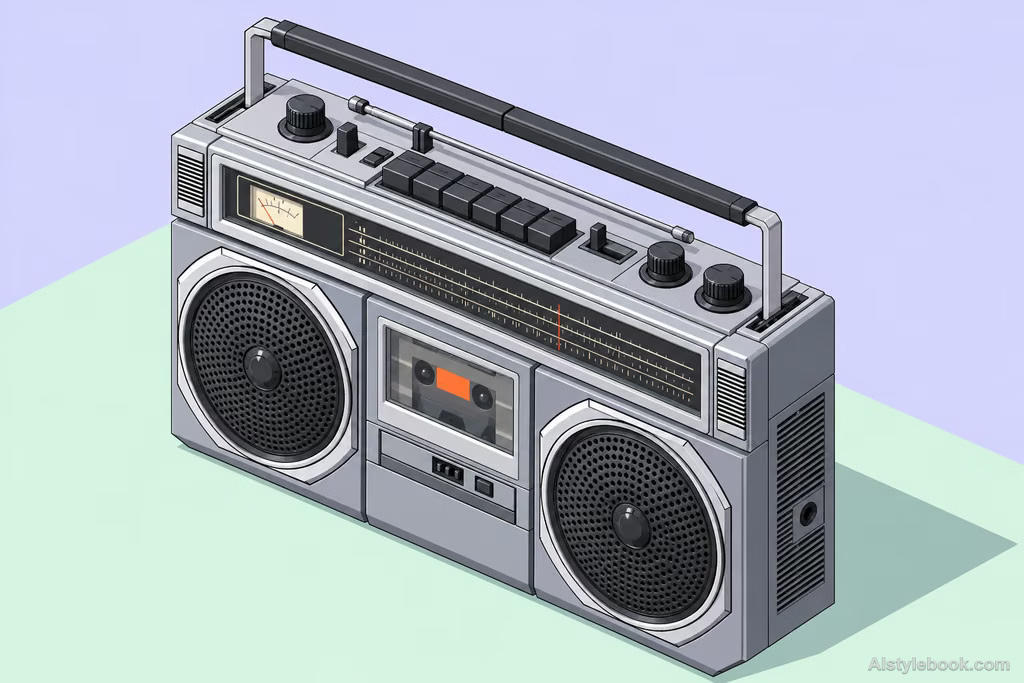
ObjectsStyle effect
The visual language
What is Isometric?
Parallel edges stay parallel with equal foreshortening along three axes. Contrasting top and side planes turn the image into a small system that can be read part by part.
Edges do not converge toward a vanishing point, so corresponding directions remain aligned across the image.
Imagine a roof removed to reveal rooms, furniture and roads together on a readable model table.
How the style changes different subjects
- Portrait
- Figures become small dimensional units, with position and pose outweighing facial detail.
- Landscape
- Buildings, roads and rooms follow consistent oblique axes like a readable spatial model.
- Objects
- Visible top and side planes turn objects into clear geometric modules.
- Subjects
- Choose rooms, building groups, equipment or arranged objects with clear orientation and modular relationships.
Bring the style to your photos
Reusable style prompt for Isometric
Use strict orthographic isometric projection with equal foreshortening along all three spatial axes. Keep the vertical axis vertical and the other two approximately thirty degrees above and below the horizontal. Parallel edges must never converge, and scale must not diminish with distance. Convey volume through clear geometry, soft pastel colors, and simple faceted shadows. Apply one consistent projection throughout and keep the subject's structure recognizable.Use the same style prompt for portraits, landscapes and objects.
Create with this styleKeep exploring


