
Fantasy & Architecture
Mycelium-Grown World
Style guide
Fine mycelial threads and soft accreted shells link the settlement into a dense organic network.
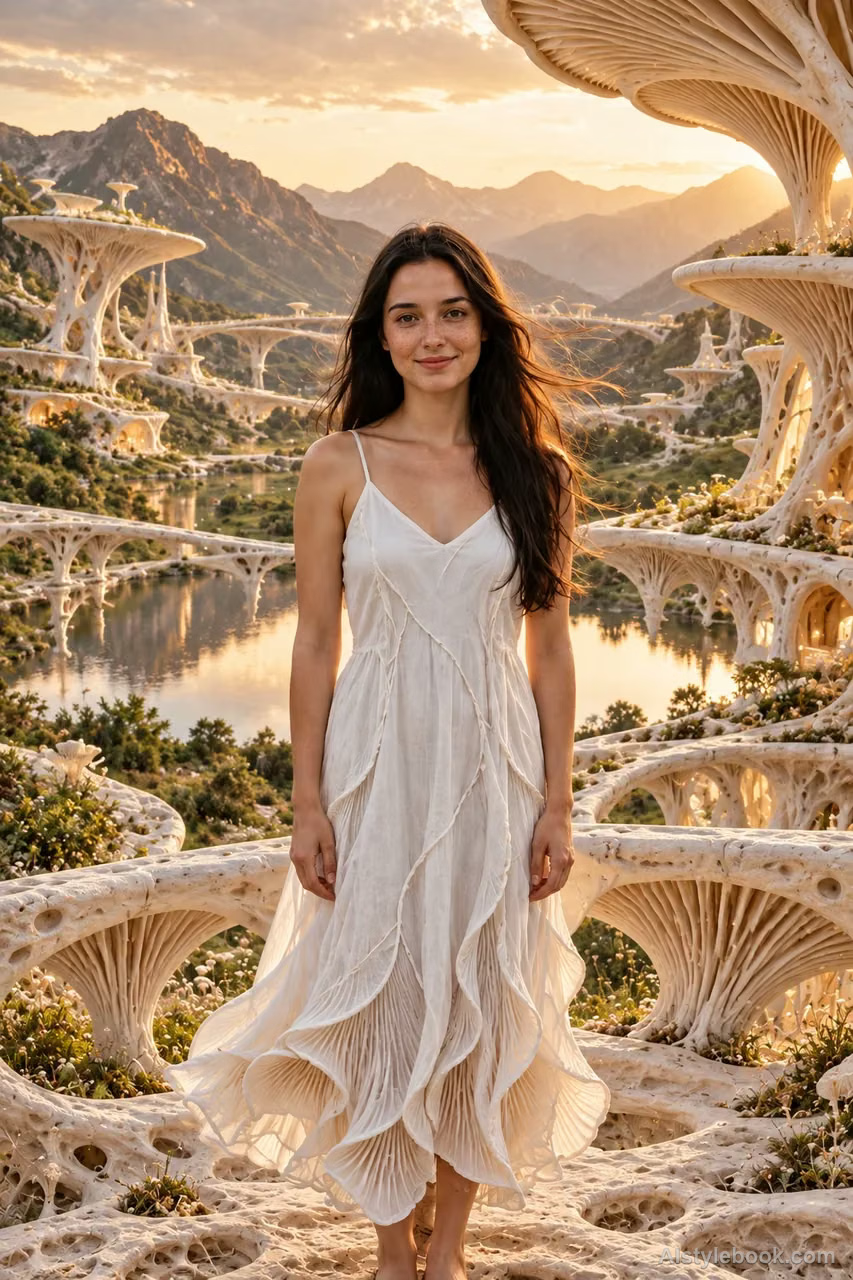
PortraitStyle effect

LandscapeStyle effect

ObjectsStyle effect
The visual language
What is Mycelium-Grown World?
Fine mycelial threads extend across surfaces to form shells, paths and pores. Fibrous softness and accreted edges unite subject and background as parts of a shared growing network.
Mycelium worlds borrow interwoven growth without proving real architectural performance.
Fibrous edges joining neighboring shells and denser strands around openings can suggest a settlement formed through one process.
How the style changes different subjects
- Portrait
- Branches, roots or fibrous networks extend body and clothing into growing organic forms.
- Landscape
- Growth connects buildings and routes into continuous, plant-like space.
- Objects
- Growing cavities and connecting tissue replace manufactured seams with irregular surfaces.
- Subjects
- Choose trees, arches, building groups, animals or curved objects with a clear base for branching growth.
Bring the style to your photos
Reusable style prompt for Mycelium-Grown World
Translate existing forms into mycelium-grown construction. Let pale fibrous masses fuse naturally at connections, turning existing volume changes into gill-like layered edges and softly irregular supports. Fine fiber bundles and joint veins reveal growth direction. Keep surfaces matte and finely porous, using cream, gray-beige and pale brown. Gentle side light emphasizes thin layered edges and fused bases, giving the structure a lightweight grown quality while retaining original contours.Use the same style prompt for portraits, landscapes and objects.
Create with this styleKeep exploring


