
3D & Miniatures
Spline-Ribbon Forms
Style guide
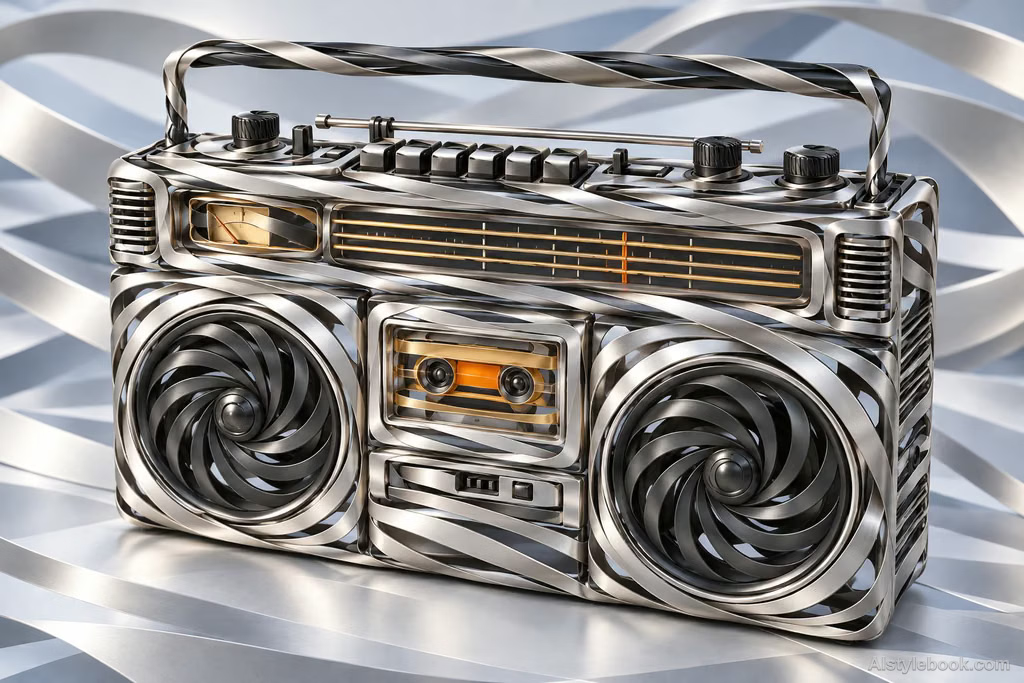
Wide thin satin ribbons twist and layer around volumes, using alternating cross-section tones and open gaps for elegant flowing structure.

PortraitStyle effect

LandscapeStyle effect
ObjectsStyle effect
The visual language
What is Spline-Ribbon Forms?
Wide thin ribbons twist along the volume, with alternating bright and dark cross-sections establishing rhythm. Genuine gaps between layers make the form consist of continuous strips rather than stripes on a solid surface.
Spline ribbons build volume from a continuous thin band whose face and edge alternate as it twists.
A ribbon vase with visible gaps can reveal its path instead of resembling a striped solid shell.
How the style changes different subjects
- Portrait
- Continuous strips, tubes or linked bands rebuild features and body with visible gaps and direction.
- Landscape
- Bundled linear structures replace ordinary scenic surfaces with coherent paths.
- Objects
- Wrapped bands, pipes or chains model curves through connections and bends.
- Subjects
- Choose flowing hair, branches, curved sculptures or rounded objects with clear directions for continuous material.
Bring the style to your photos
Reusable style prompt for Spline-Ribbon Forms
Rebuild the image from continuous, broad, thin sculptural ribbons that bend along existing volumes and contours, with visible twisting cross-sections and deliberately designed open gaps. Use narrow bands for fine details and wide bands for broad surfaces. Alternate front-and-back highlights, keeping ribbon edges clear and satin reflections soft. Maintain cohesive subject colors and elegant layered flow with recognizable structure. Avoid tangled fine wires or a flat contour-line filter.Use the same style prompt for portraits, landscapes and objects.
Create with this styleKeep exploring


