
Printmaking & Printing
Mezzotint
Style guide
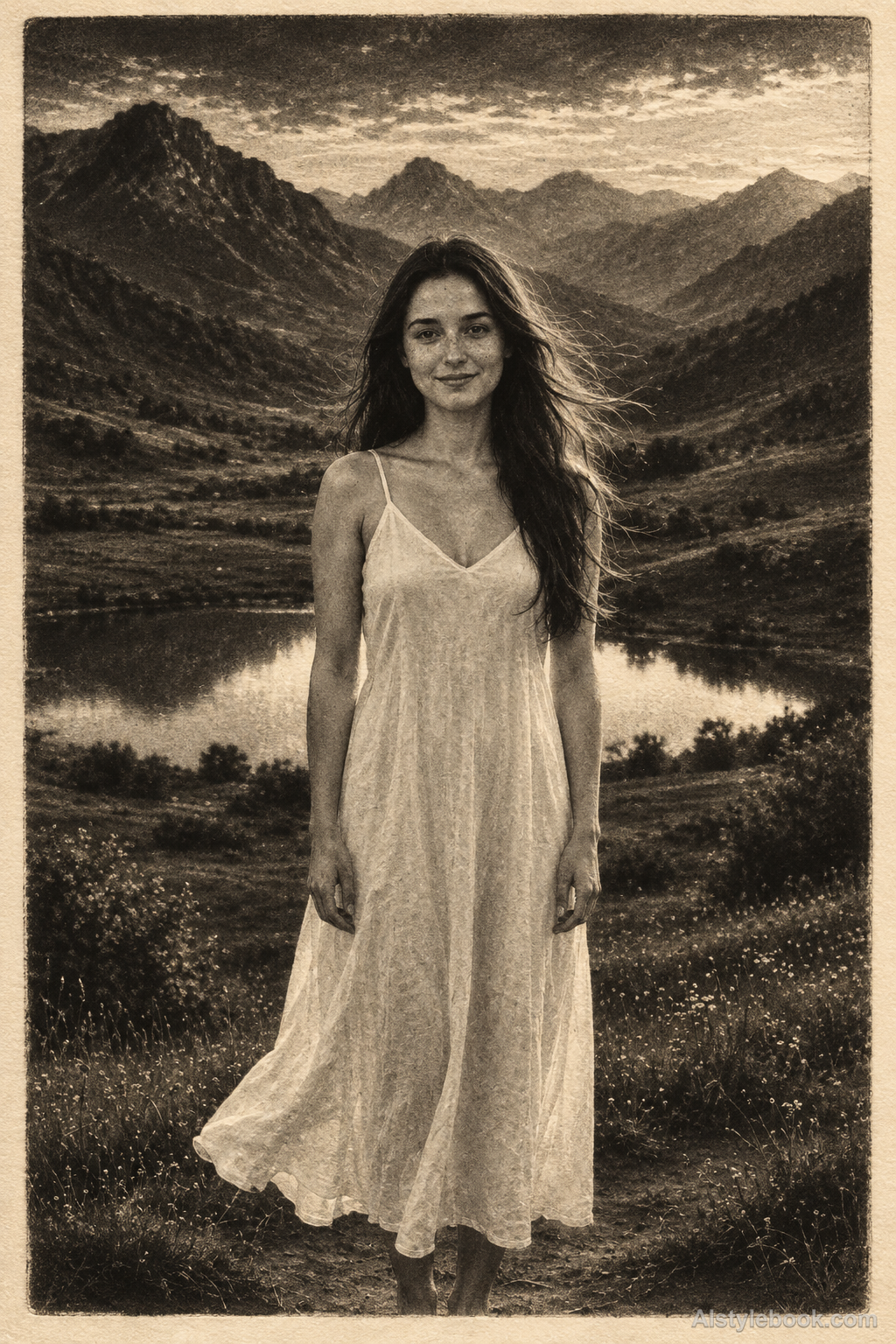
Soft light emerges from velvety black through fine irregular grain and gently graduated intaglio tone.


The visual language
What is Mezzotint?
The visual focus of mezzotint is light emerging gradually from black. Dense fine grain gives shadows a velvety surface, while highlights appear softly burnished toward paper white. Supple edges and continuous middle tones carry more weight than engraved lines.
Mezzotint begins with a roughened plate that prints dark, then reduces ink retention through smoothing.
A bottle's edge emerging from velvety black can gain volume without prominent engraved lines.
How the style changes different subjects
- Portrait
- Fine granular tones replace skin color, allowing soft dark backgrounds to frame expression.
- Landscape
- Sky, mist and terrain become quiet continuous tonal grain.
- Objects
- Grain density models objects as highlights emerge from darkness and original color recedes.
- Subjects
- Choose softly side-lit portraits, mist, still lifes or night scenes with varied middle tones.
From seventeenth-century plates to British tonal prints
Mezzotint developed in seventeenth-century Amsterdam. Ludwig von Siegen completed his portrait of Amelia Elizabeth of Hesse in 1642, an important early example. The technique later spread widely in London and was frequently used to reproduce oil paintings in the eighteenth century, its soft tones and velvety blacks conveying painted light and texture.
Artists & practitioners
Creators to know
Ludwig von Siegen
An important early investigator of mezzotint whose 1642 portrait of Amelia Elizabeth documents an early stage of tonal intaglio.
Wallerant Vaillant
An early professional mezzotint engraver active in Holland whose extensive work helped the technique gain wider use.
Bring the style to your photos
Reusable style prompt for Mezzotint
Interpret the image as a monochrome mezzotint intaglio print on warm heavy paper. Begin visually with a densely textured velvety-black ground and reveal forms through softly scraped and burnished highlights. Build middle tones from extremely fine irregular grain, allowing deep dark areas to remain rich and continuous while light passages fade delicately toward paper white. Keep edges selectively soft and surface transitions luminous. Include a faint plate impression, avoiding regular halftone grids, visible pen dots, crosshatching or hard photographic solarization.Use the same style prompt for portraits, landscapes and objects.
Create with this styleKeep exploring


