
Paper & Collage
Natural-Material Assemblage
Style guide
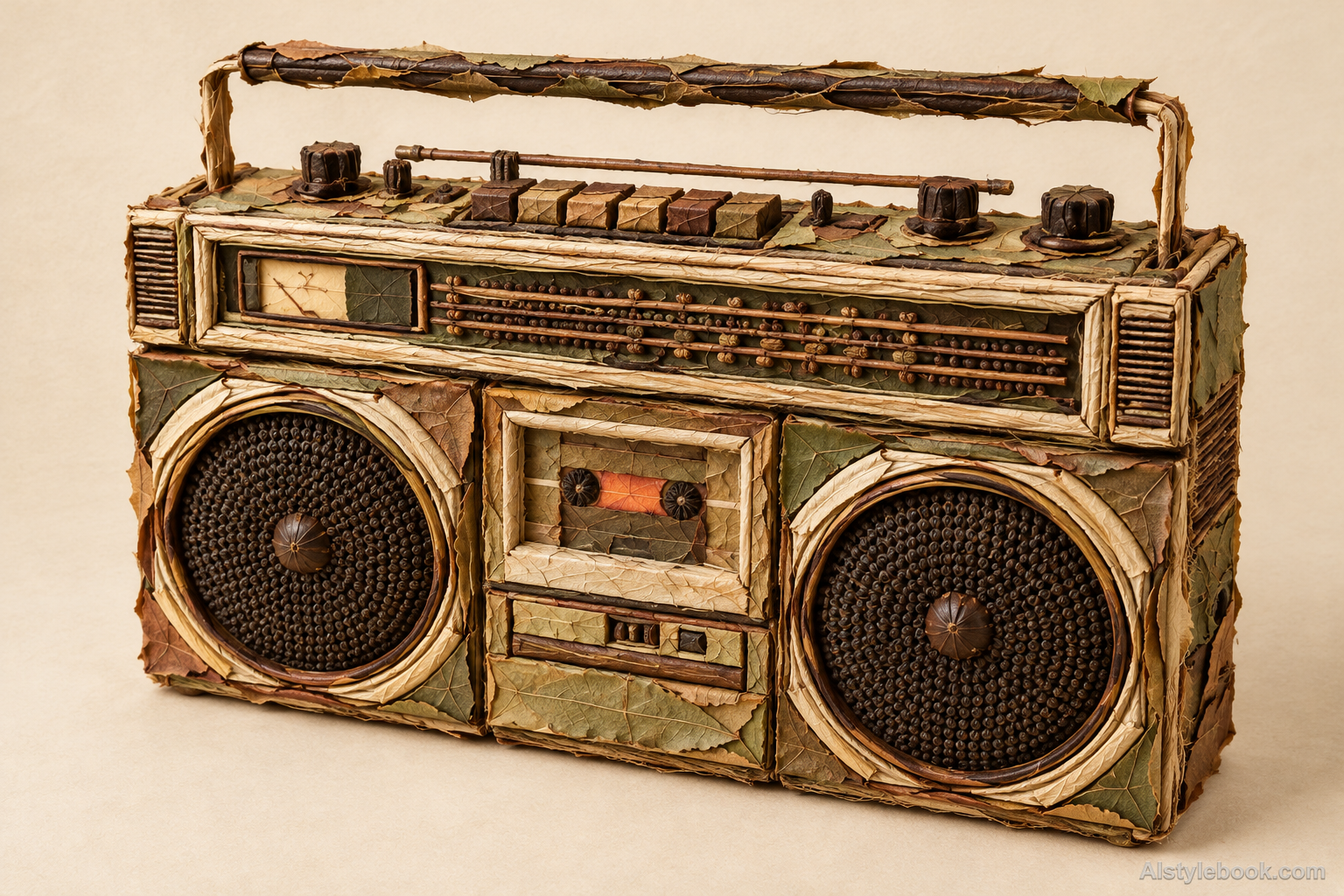
Unpressed leaves, twigs, seeds and petals assemble into raised forms with curled edges and visible contact shadows.


The visual language
What is Natural-Material Assemblage?
Unpressed leaves, twigs, seeds and petals assemble into raised forms with curled edges and visible contact shadows. Warm paper supports natural color differences.
Natural-material assemblage preserves the original thickness and shape of its components.
Twig beams and overlapping leaf roofing can remain readable through lifted edges and contact shadows.
How the style changes different subjects
- Portrait
- Recognizable natural fragments rebuild face and clothing, leaving broad contours to carry identity.
- Landscape
- Layered fragments recreate terrain and plants with leaf, fiber or feather-like textures.
- Objects
- The silhouette remains while natural materials and their joined edges replace the surface.
- Subjects
- Choose animals, flowering stems, profiles or simple still lifes with contours that tolerate fragment shapes.
Variant relationship
A dimensional-material variant of Pressed Botanical Collage. Compare with Pressed-Plant Picture.
Pressed Botanical Collage flattens plant matter into thin graphic shapes. This variant retains bent leaves, seed volumes and layered thickness, using contact shadows and curled edges to suggest a small material assemblage.
Bring the style to your photos
Reusable style prompt for Natural-Material Assemblage
Preserve the source identifying silhouette, pose and arrangement. Reconstruct it as a photographed raised assemblage of actual unpressed leaves, slender twigs, seeds, dry petals and plant fibers on warm neutral paper. Make the material thickness, curled edges, curved twigs and cast contact shadows clearly visible. Use natural muted plant colors and careful source-based placement. Maintain identifying silhouettes and construct every existing subject from the same natural materials. Avoid a flat pressed-flower picture, illustrated botanical textures, painted plastic, extra living animals, unrelated still-life props, collage labels or text.Use the same style prompt for portraits, landscapes and objects.
Create with this styleKeep exploring


